
n8n vs Google ADK: Comparing Agent Frameworks in 2025
Estimated Read Time: 5mins
As AI agents move from experimental chat interfaces to production orchestration, you may face a critical choice: Low-code procedural workflows or Code-first agentic frameworks? In this post, we compare n8n, the leading workflow automation tool, with Google’s Agent Development Kit (ADK) to help you decide which architecture fits your use case.
The Contenders at a Glance
n8n: The Visual Orchestrator
n8n orchestrates agents within a visual, flow-based architecture. Unlike rigid linear pipelines, it supports complex logic including loops and branching. With over 1,000 integrations, it excels at API connectivity, while its AI Agent Node (wrapping LangChain) allows you to seamlessly inject reasoning capabilities into any part of your automation graph.
Google ADK: The Stateful Architect
Google ADK (Agent Development Kit) is a framework designed for building complex, multi-agent systems. Unlike a workflow tool, ADK treats agents as stateful objects that operate in loops (Reason → Act → Observe). It is built to handle non-linear conversations and autonomous handoffs natively.
Examination scenario 1 – Multi Agent Setup
We used the following demo setup:
- A root agent which uses other (sub)agents to support user requests: weather_agent and fortune_teller_agent
- A weather_agent which is instructed: “You are a weather agent and help the user to answer questions about the weather in a specific city” and using a code tool / python function for getting the weather in a specific city
- A fortune_teller_agent with a simple instruction: “You are a fortune teller. You need 3 numbers to tell the fortune. If (sum of the numbers) modulo 3 == 0 then tell: prosperous future, if 1 then tell: long life, if 2 then tell: happy family”. No additional tools.
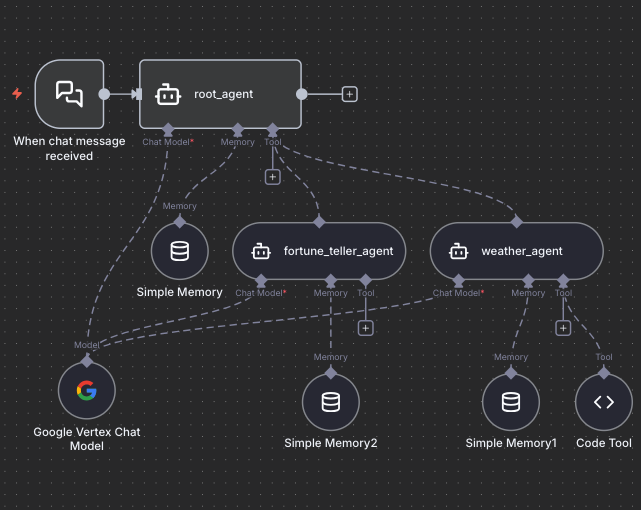
n8n allows to set up a multi-agent scenario by combining the AI Agent Node with Tools AI Agent Nodes or by connecting it to agents wrapped in their own workflow via the Call n8n Workflow Tool Node. The interaction is stateless by default, but agents can be extended with memory nodes. The memory node keeps track of the conversation and is configured by the context windows length of the chat history. It is possible to connect multiple agents with the same memory node for the purpose of a shared memory. We set up a scenario with a manager agent who was only instructed by delegating questions to sub agents
n8n setup
n8n allows to set up a multi-agent scenario by combining the AI Agent Node with Tools AI Agent Nodes or by connecting it to agents wrapped in their own workflow via the Call n8n Workflow Tool Node. The interaction is stateless by default, but agents can be extended with memory nodes. The memory node keeps track of the conversation and is configured by the context windows length of the chat history. It is possible to connect multiple agents with the same memory node for the purpose of a shared memory. We set up a scenario with a manager agent who was only instructed by delegating questions to sub agents.
adk setup
We set it up straightforward in Python code as you see below.
Execution
We used the interaction sequence
- Ask what the agent can do for me
- Let it tell the fortune
- Ask then for the weather at the current place
Results
adk handled the sequence correctly and reliably. As expected the root_agent handed over to the fortune_teller_agent which handed over to the weather_agent. The weather agent was not able to interpret “here”, so is asking for clarification. You can see in the web tool from adk the colored agents as well as the events which are a core element of the Event Loop architecture.
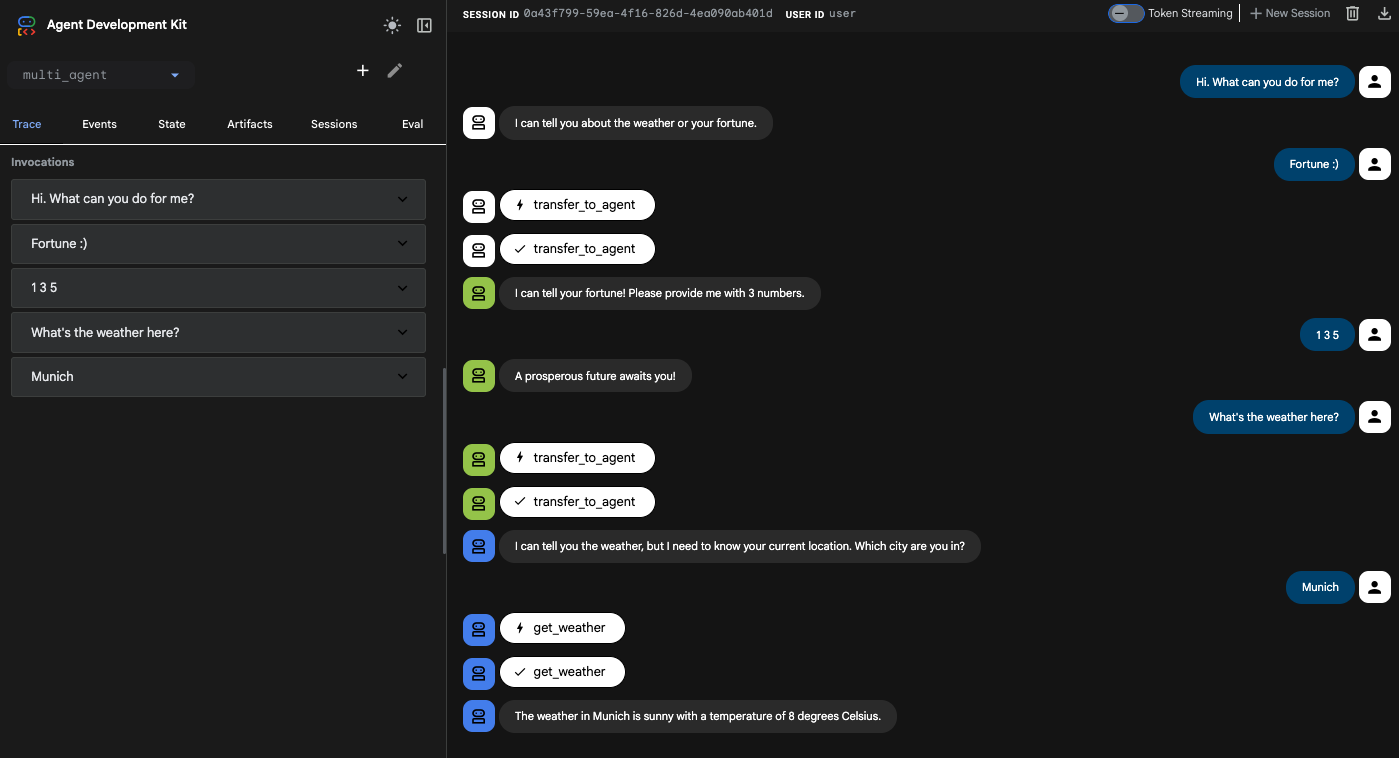
n8n did perform the test also quite well. However the technical call chain was in general more difficult to comprehend. At some executions it did not complete the request for the weather: While understanding and asking the user for the city it was not able to finish the request. Other executions went fine.

Examination scenario 2 – More complex reasoning
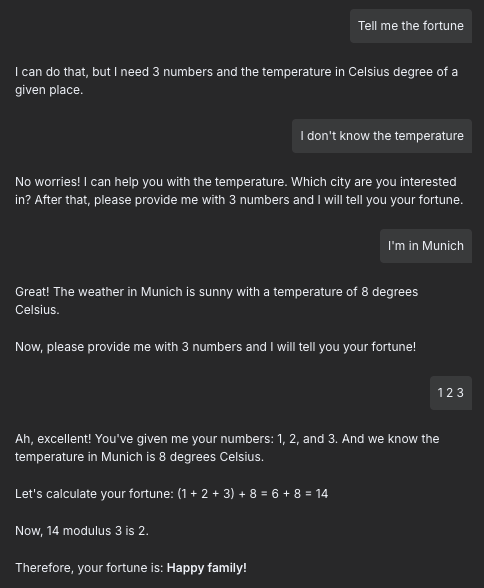
Same setup as before. We only changed the fortune_teller_agent by including the temperature. By that we wanted to see that the fortune_teller_agent makes use of the weather agent.
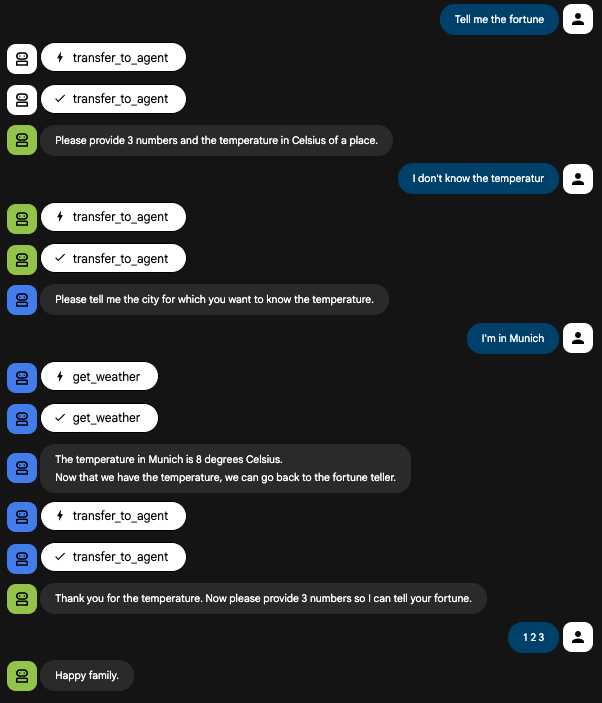
adk performed well. Upon telling that “I don’t know the temperature” the fortune_teller_agent handed over to weather_agent to help which after the handling handed back to the fortune_teller_agent: “The temperature in Munich is 8 degrees Celsius. Now that we have the temperature, we can go back to the fortune teller.”
Same for n8n. The interaction flow was here as expected.
Examination summary
Both setups were able to show the as wanted behavior. Adk was performing constantly reliable. The web ui provides good insights to the interaction and call flow.
The n8n setup could be done purely via the UI with minimal coding (except the weather tool). It had sometimes dropouts as we depict in scenario 1. The interaction and call flow was difficult to understand.
As we favor the clear and understandable event loop architecture and the web ui to inspect the events, we would prefer using Google adk to develop such scenarios. However n8n, which is not agent framework in the first place performed quite well.
Let’s finish the article with our recommendation, when we use adk or n8n.
The Verdict:
If you need rapid prototyping and extensive 3rd-party integrations, n8n is the superior choice. However, for complex, stateful multi-agent systems requiring non-linear reasoning and strict production control, Google ADK provides the necessary architectural robustness.
And in more details:
| Google ADK recommended when: | n8n recommended when: |
|---|---|
| Technically ambitious, complex reasoning agents, e.g. utilizing tools to discover a Open API Webservice Specification and acting with it. | Process-oriented, linear automation. Ideal when an agent is supposed to perform a specific step in a workflow. Be aware that it triggers at every interaction answer to the following process so you might need to define some kind of linguistic control, i.e. “after you collected all the required input from the user, confirm the input and say ‘input complete'”. |
| Requirements for higher technical control, such as state management. State management helps to distill necessary session information into variables. This is very helpful to keep the token utilization on a lower level instead of collecting and passing the whole interaction history to each step. | More straightforward tooling and supportive agents for daily tasks: When receiving message, triage and send to Teams channel abc. |
| When requiring persistent fact storing which is provided by memory bank (though Google ADK is agnostic of LLM and deployment, there are some features which come exclusively from the Google Cloud platform and agent engine). A nice blog to read more about it can be found in this Google Blog | Excels in pre-implemented tools and integrations. |
The agentic helpers
Moving from experimental chat interfaces to production orchestration is difficult. At codeitlabs, we specialize in building robust agentic infrastructure. Contact us today to discuss which framework fits your enterprise needs.